Wednesday, June 4, 2014

city of redlands pd's new mrap


The City of Redlands Police Department invited reporters and photographers to view their decommissioned military surplus Mine Resistant Ambush Protected vehicle for the first time Wednesday June 4.

"Redlands Police Rescue" is stenciled on the sides of the flat-black painted International MaxxPro MRAP, which cost taxpayers more than $500,000 to manufacture, according to the Department of Defense.

Redlands PD acquired its MRAP in September 2013, along with police from the cities of Banning, West Covina and Gardena. The Banning police MRAP sustained two blowouts and crashed into a civilian's pickup truck during the convoy from Fort Bliss in El Paso, Texas. The Redlands police MRAP sustained no damage in the crash.

Ray Rodriguez, a City of Redlands truck driver, told Watershed News he drove the Redlands MRAP to Los Angeles and back about two months ago for its paint job, and it handled "like a Cadillac."

"I left a nickel on the back of the bumper here, and drove it from L.A. to Redlands, and it stayed on there," Rodriguez said. "When I got here it was still on the bumper."

Rodriguez said he got several reactions from other motorists.

"A lot of thumbs up. Some were blowing kisses. . . . the girls were blowing kisses."

Redlands Police Chief Mark Garcia describes his department's MRAP as a "rescue vehicle" to improve RPD's ability "to protect our community against any threats."

The ballistic rescue vehicle is a tool police can use in response to an active shooter or similar volatile, violent incident, Garcia says.

"The vehicle, provided at no cost to the City, was one of some 165 of the surplus vehicles provided to police departments nationwide as part of a national military surplus program started by President Bill Clinton in the 1990s," City of Redlands spokesman Carl Baker said in a statement distributed Wednesday.

"The Redlands Police Department applied for the MRAP to repurpose as a ballistic capable rescue / tactical vehicle that could be used to enhance the safety of officers and the public when responding to active shooter-type incidents," Baker said.

"Since that time, the department has repainted the vehicle and reconfigured the interior to make it suitable for its deployment as a rescue vehicle. While the vehicle includes a turret that will serve as an observation platform for officers, there are no weapons mounted on the vehicle," Baker said.

"The $28,000 cost to retrofit the vehicle was paid for entirely with asset seizure funds - the allocation RPD receives from the proceeds of property seized from convicted drug dealers. No General Fund money was used to purchase or retrofit the vehicle."

Redlands Police MRAP: June 4 2014

The MRAP is a military vehicle, "so the military paid money for it, which comes from taxpayer money generally, but in the City of Redlands, when the military re-purposed that vehicle to us for our police department, we have not spent any taxpayer money on the vehicle," Garcia said in an interview Wednesday.

Redlands Police did not have an armored vehicle at their disposal prior to their MRAP acquisition, but they could call "any police agency that has an armored vehicle and ask their assistance, so we're dependent upon them whether they have personnel to bring the vehicle in, whether their vehicle's even available if they're not using it," Garcia said.

"There's been times we've served search warrants that are high risk search warrants, that we've had other agencies bring in an armored vehicle to move the SWAT people into position to contact the suspects."

Inside the Redlands Police MRAP: June 4 2014

Garcia and the Police Department did not bring the MRAP acquisition to the City Council for approval or discussion, public or otherwise.

"The City Council does not have to approve the acquisition of a free vehicle," Garcia said Wednesday. "As the Chief of Police, I had the opportunity to do this, and made the decision that we needed to add something like to this our department to keep our officers safe."

View from turret of Redlands Police MRAP: June 4 2014

Given the incidents local police and deputies face from time to time, it's no surprise law enforcement agencies are willing to accept free combat-ready MRAPs with roof-mounted machine gun turrets.

But as the Department of Defense continues giving away vehicles designed for "asymmetric warfare," the American Civil Liberties Union and others have criticized what they describe as the increasing militarization of local law enforcement agencies, according to an Associated Press report published by the Military Times.

 Garcia dismissed such criticism as "ignorant."

"I think that's an ignorant position that somebody would say we're militarizing our police department because we use an armored vehicle to protect our officers," Garcia said.

"If a reporter was using a camera that was a high tech camera that could see a far distance and the military was using the same camera, would we make the same accusation against the reporter, that he was militarizing his craft by using the same type piece of equipment? I don't think so.

"I think that yes there's crossover in the types of tools that we might use with the military," Garcia said. "That has nothing to do with trying to militarize a police department.

Redlands Police MRAP: June 4 2014

"I know that for us, having previously been in San Bernardino, there were a couple of times where when soldiers were going to Iraq, they came and trained with our SWAT team to learn the tactics of how to go door-to-door, how to talk to people, and how to make contact in those types of situations."

Prior to coming to Redlands in 2011, Garcia was with San Bernardino PD beginning in 1987. In San Bernardino his duties included SWAT commander, and he was "actively involved in decisions to assist military units" that were going to Iraq in the mid-2000s, he said.

"So we're not going out and getting the military to train us, but the military has at times found it beneficial to be trained by police departments. I don't think there's any issue with militarization just because we're using a similar type of vehicle."

Redlands Police personnel and the department's MRAP: June 4 2014

Documentation shows the MRAP averages about 6.8 miles per gallon, Garcia said.

"We don't get'em for their mileage, we get'em for their protection capabilities . . . Any high risk situation. We're seeing incidents in Oakland and Pittsburgh where people have shot at the police, and they were in armored vehicles and that armored vehicle protected them. Any time you have to go into the line of fire it's not something to look forward to, but it's something we willingly do because that is our role in society is to help protect people."

All photos by Guy McCarthy

For more background see:

UPDATE: Police Acquisition of Armored Vehicles, Costly Crash Under Scrutiny

UPDATE: Councilman Blasts PD's Acquisition of MRAP Vehicle, City Manager 'Not Happy'

KESQ in December:

http://www.kesq.com/kesq/city-police-at-odds-over-military-vehicle/23555980


Washington Post roundup in April this year, including mention of Banning:

http://www.washingtonpost.com/news/the-watch/wp/2014/04/29/reader-submissions-from-small-towns-that-are-militarizing-their-police-forces/

-30-

Tuesday, May 13, 2014

fire danger: big santa anita canyon

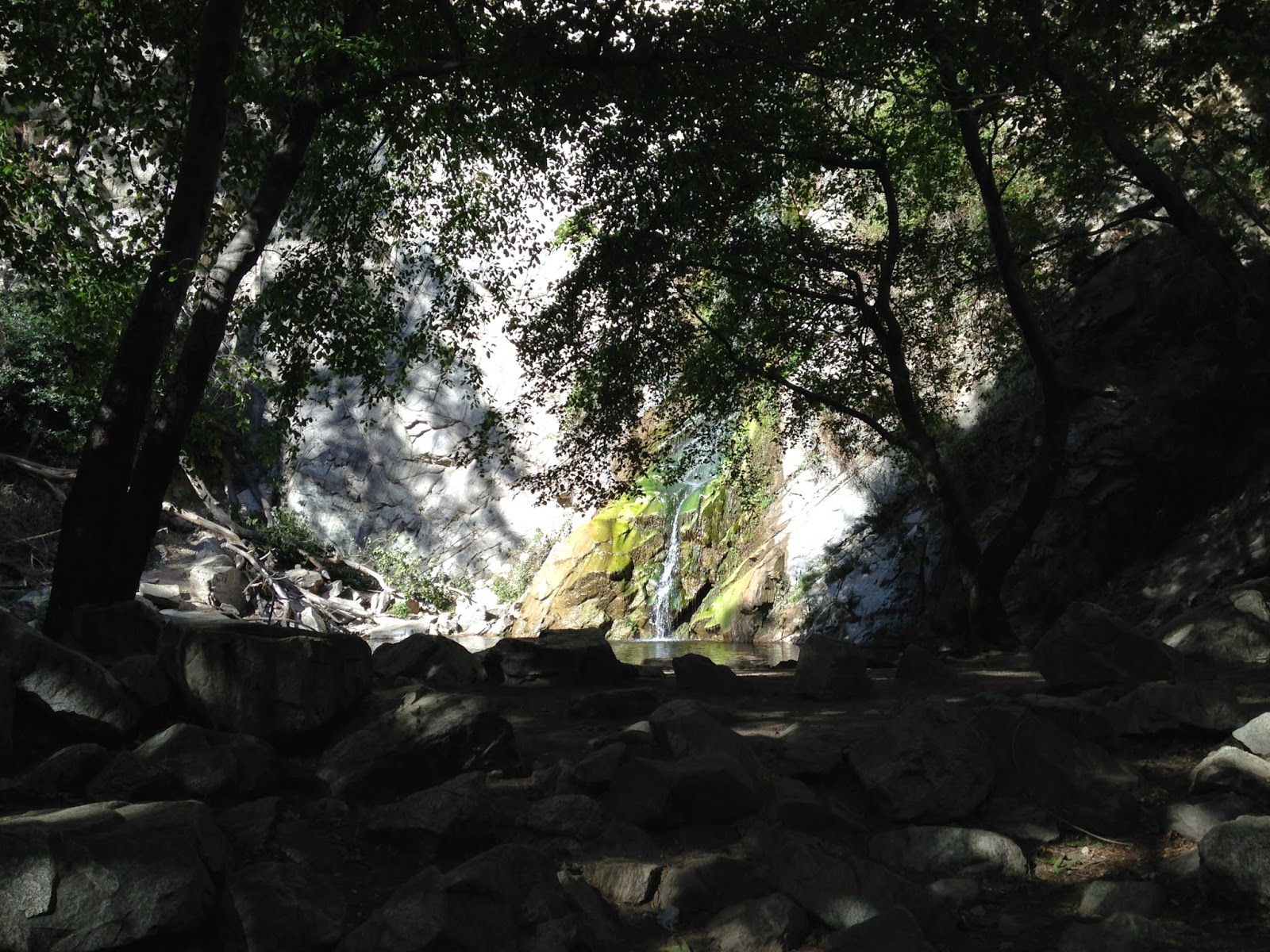
Cool under the canopy: Sturtevant Falls May 12 2014

With red flag warnings for heightened fire danger across SoCal in place through Wednesday evening, City of Sierra Madre officials have closed access to several trails including those in Big Santa Anita Canyon.


The city tweeted the exact same announcement at 8:18 a.m. Monday May 12, but by that time several people were already on trails in Big Santa Anita, including me.

I walked past Spruce Grove and Sturtevant Camp to get up to Mt. Wilson, and found a Los Angeles County Flood Control marker near the summit, where you might expect to see a U.S. Geological Survey benchmark.

Marker overlooking Big Santa Anita Canyon

Whatever the marker signifies, it's a fact L.A. County Flood Control and the Forest Service installed numerous check dams in Big Santa Anita in the early 1960s to slow erosion in the cabin-strewn lower canyon.

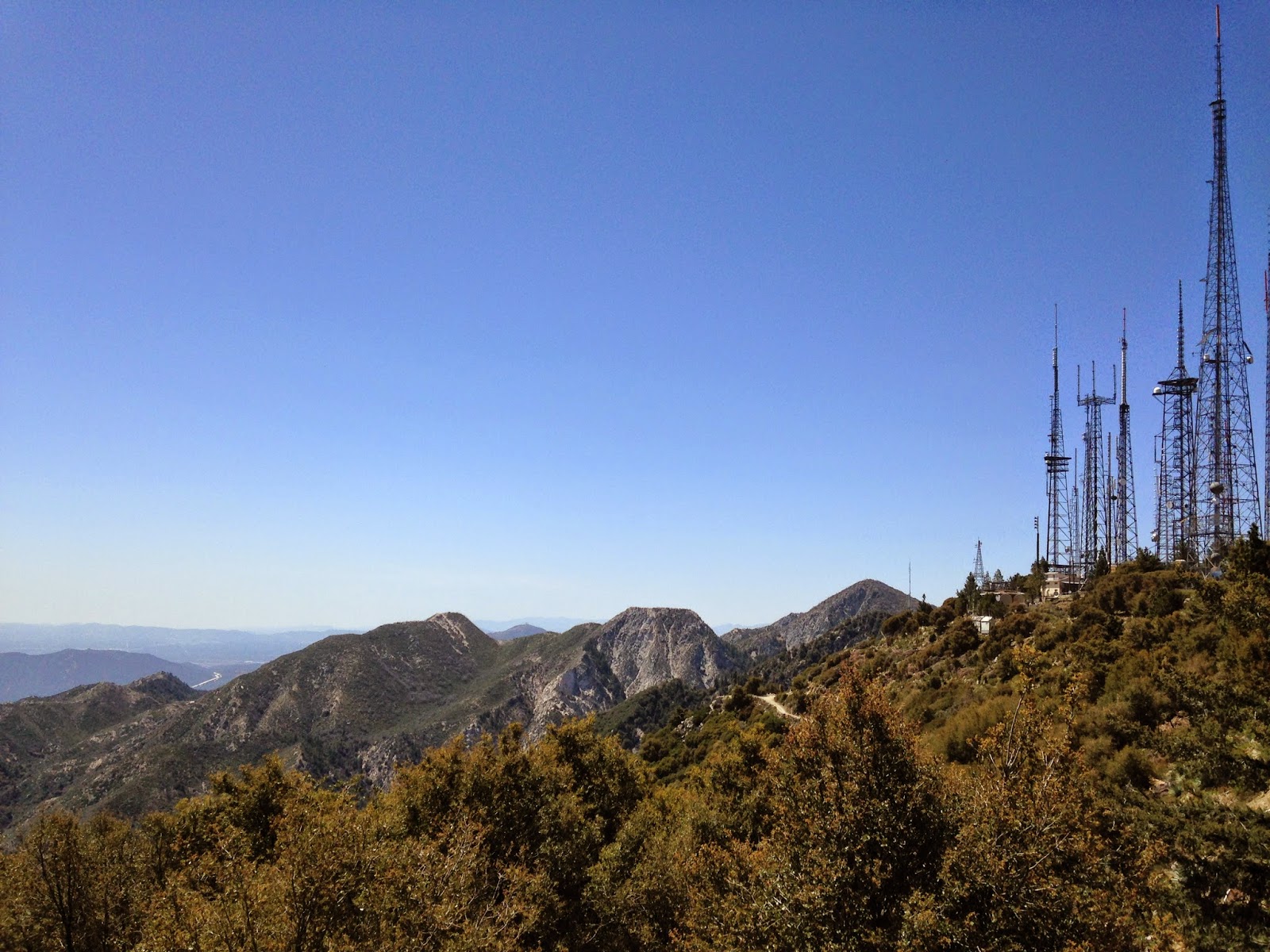
The view looking east from Mt. Wilson includes Mt. San Antonio, aka Baldy, on the Los Angeles-San Bernardino county line.

San Gabriel Mountains in L.A. County: May 12 2014

On top of Mt. Wilson are numerous observatories, including the 100-inch Hooker Telescope dome that became operational in 1917.

Historic telescope dome on Mt. Wilson: May 12 2014

There's also the antenna farm from which TV stations transmit across the L.A. designated media market.

Antennas on Mt. Wilson: May 12 2014

The Station Fire, largest in Los Angeles County history, threatened Mt. Wilson in late August and early September 2009. Inside an observatory museum on the summit is a photograph reminding visitors of the ever-present fire danger.

Displayed in Astronomical Museum on Mt. Wilson

I walked past Mt. Harvard and down Winter Creek to Chantry Flat. Driving out I found the road gate in Sierra Madre closed and apparently locked. With the help of a local mountain biker I got it open and headed home.

As of Tuesday afternoon, red flag warnings remained in effect for Los Angeles, San Bernardino, Riverside, San Diego and Ventura counties through 8 p.m. May 14, according to the National Weather Service.

Update 6:20 p.m. The Bernardo Fire burning in north San Diego County prompted officials to order evacuations for residents of more than 20,000 homes and residences in the 4S Ranch, Fairbanks Ranch and eastern Rancho Santa Fe areas, according to sheriff's and county officials.

An evacuation point was set up at Torrey Pines High School, 3710 Del Mar Heights Road.

The fire was reported about 11 a.m. Tuesday off Nighthawk Lane southwest of Rancho Bernardo, according to Cal Fire. It was estimated at 800 acres with 5 percent containment.

-30-

Monday, May 5, 2014

usfs: illegal campfire ignited $4M etiwanda blaze

Perimeter map of Etiwanda Fire burned area: Esri, USGS

Investigators believe an illegal campfire sparked the 2,190-acre Etiwanda Fire that roared out of Day Canyon last Wednesday on howling Santa Ana winds and prompted mandatory evacuation orders for residents of more than 1,600 homes in Rancho Cucamonga, a Forest Service spokesman announced Monday.

No arrests had been made and authorities were seeking help from the public.

The fire was first reported about 8 a.m. April 30 in the North Etiwanda Preserve area as erratic winds out of the northeast stoked the blaze and grounded firefighting aircraft. No homes sustained severe damage but a half-dozen schools were closed that day, more than 900 firefighters were called out, and three of them sustained minor injuries.

Here's the statement distributed May 5 by John Miller of the San Bernardino National Forest: 

Investigators have determined that the 2,190 acre Etiwanda Fire was started by an escaped illegal campfire.

Once conditions in Day Canyon were deemed safe, investigators hiked into the remote upper portion of the canyon, and located evidence of an illegal campfire. Investigators believe the illegal campfire may have been smoldering for a few days until the strong winds blew embers into nearby brush. Wood and charcoal fires are only permitted in designated campgrounds and picnic areas and never in the general forest area. 

Forest and fire officials are asking for the public’s assistance. If you observed any hikers, or persons in the area, during the week leading up to the fire, please call the WeTip Hotline at 800-472-7766 or submit the tip on-line at http://wetip.com/submit-anonymous-tip-2/

 As of 5 p.m. Monday the Etiwanda Fire was considered 96 percent contained, according to the Fire Service. The estimated cost of fighting the fire and ensuring it's completely out was unclear. For more info see http://inciweb.nwcg.gov/incident/3848/.

Update 8 p.m.  The estimated cost of fighting the Etiwanda Fire as of Monday evening was $4 million, Carol Underhill of the forest's Front Country Ranger District said in an email.

-30-

Monday, March 31, 2014

showers expected: drought continues


Colorado River water in Lake Mathews reservoir: March 29 2014

Showers are likely this week but the spell of cooler, wetter weather is unlikely to have significant impact on drought conditions across Southern California, according to forecasters and climatologists.

More than 95 percent of California was in severe drought as of March 25, a slight increase from the previous week, according to local, state and federal scientists with the U.S. Drought Monitor. The entire state was considered abnormally dry, a figure that remains unchanged from a year ago.

The first round of showers is expected Tuesday morning and again Wednesday with total precipitation through Thursday estimated .2 to .5 of an inch west of the mountains, and .5 to 1.5 inches over the mountains, according to the National Weather Service. Mountain snow levels could drop to 4,500 feet by Wednesday morning.

Lake Mathews from La Sierra Avenue: March 29 2014

The Lake Mathews reservoir was completed in 1939 by the Metropolitan Water District of Southern California as the western terminus of the Colorado River Aqueduct, according to Riverside County Integrated Project officials.

The maximum capacity for Lake Mathews is 182,000 acre feet, or 59.3 billion gallons, according to MWD.

On Saturday March 29, grass and other plants were growing on edges of the shore exposed by lower levels at the reservoir.

Lake Mathews south of Riverside: March 29 2014

The 242-mile Colorado River Aqueduct begins at Parker Dam southeast of Lake Havasu City, Arizona. It was conceived by William Mulholland and designed by Frank E. Weymouth of MWD, and it was built between 1933 and 1941 by the Metropolitan Water District of Southern California, according to Water and Power Associates. The aqueduct was the largest public works project in Southern California during the Great Depression.

The Metropolitan Water District, established in 1927, serves about 19 million people in a 5,200-square-mile area in Los Angeles, Orange, San Diego, Riverside, San Bernardino and Ventura counties. The district's water sources are the Colorado River and California State Water Project, according to MWD.

Lake Mathews reservoir: March 29 2014

The district's facilities include the aqueduct, pumping stations, Diamond Valley Lake, Lake Skinner, and other reservoirs in La Verne, Monterey Park and Palos Verdes, according to MWD.

Los Angeles Department of Water and Power rates for single-dwelling unit residential customers are up this year to $4.68 per hundred cubic feet, or 748 gallons, an increase from $3.96 in 2013, according to DWP.

The Department of Water and Power, the nation's largest utility, gets water from sources including the Sierra Nevada via the Los Angeles Aqueduct, the State Water Project, the Metropolitan Water District, and groundwater basins.

Lake Mathews and exposed shoreline: March 29 2014

Big Bear Lake, which relies solely on precipitation that falls in the San Bernardino Mountains, has a capacity of 73,370 acre feet, according to Big Bear Municipal Water District.

As of Monday, Big Bear Lake was "pretty close to 52,000 acre feet, and 8 feet below full," BBMWD general manager Scott Heule said in a phone interview.

"It's down significantly over the last two years, not just this year," Heule said March 31. "We didn't get the inflow over the winter that we typically get."

When the lake level is below 6 feet none of its water goes to customers, and the lake is used strictly for recreation and fishery maintenance, Heule said.

"The point we want to stress is there's plenty of lake surface to recreate on," Heule said. "When it's full the lake surface is about 3,000 acres. Right now it's about 2,500 acres."

Lake Mathews is fenced and closed to the public.

Photos by Guy McCarthy

-30-

Wednesday, March 26, 2014

storm winds expected through thursday


Looking northwest from south Riverside: March 26 2014

A weak storm system continued moving across Southern California late Wednesday, with periods of light rain and strong winds in some mountain and desert areas, the National Weather Service advised.

Preliminary 24-hour rainfall totals as of 9 p.m. March 26 included .57 of an inch measured at Devore, .39 inch at Cal State San Bernardino and .11 inch in Temecula, according to the Weather Service.

A wind advisory was extended to 10 p.m. Thursday.

"A low pressure trough moving across the southwest will continue to bring strong westerly winds to the mountains and deserts tonight and Thursday," a Weather Service update stated.

"However . . . they will not be quite as strong as Wednesday when winds gusted over 65 mph in the lower deserts and produced widespread areas of blowing dust and sand. Instead . . . winds will range from 20 to 30 mph with gusts to 50 mph. . . . Winds will decrease Thursday night."

Sunny weather is expected Friday, Saturday and Sunday, with daytime highs in the 60s to low 70s for Banning and Beaumont, forecasters said.

Photo by Guy McCarthy

-30-

Saturday, March 22, 2014

update: forest falls teen remains unaccounted for


Update 10:54 a.m. March 23 A teenage girl from Forest Falls who was last seen Thursday remained unaccounted for as of Sunday morning, a sheriff's spokeswoman said in a phone interview.

A deputy contacted family of Misty Dawn Laur, 15, on March 23 and she had not been heard from, said Jodi Miller of the San Bernardino County Sheriff's Department.

"While it does appear she is voluntary missing and there is no indication of foul play, we request anyone with information to give us a call," Miller said.

Anyone with info about Misty was urged to call Sheriff's Dispatch at (909) 387-8313 or the Yucaipa Station at (909) 790-3105. 

Update 10:49 a.m. A 15-year-old girl from Forest Falls was believed missing as of Saturday morning, a spokeswoman for the San Bernardino County Sheriff's Department said in a phone interview.

Misty Dawn Laur was believed to be "voluntary missing" and there was no indication of foul play in her disappearance, Jodi Miller of the Sheriff's Department said.

"We did receive a report from family members yesterday morning about her missing," Miller said. "Yesterday we did search - ground search, aerial search, and we had blood hounds search trails she often hikes. We searched all day, exhausting leads, and she was not located."

A deputy based in Forest Falls spoke to Misty's parents Saturday morning and she had not been heard from, Miller said.

Anyone with info about Misty's whereabouts was urged to call the sheriff's Yucaipa Station at (909) 790-3105 or Sheriff's Dispatch at (909) 387-8313. 

Posted 10:29 a.m. A teenage girl believed last seen Thursday March 20 has been reported missing in Forest Falls, and searches including sheriff's personnel and volunteers had turned up no sign of her as of Saturday morning, according to residents of the mountain town.

Forest Falls resident Jamie Graham contacted Watershed News before 8 a.m. Saturday and shared the following with a photo of Misty:

MISSING!!!!!!!!!! This is Misty Laur. She is a teenage girl missing from Forest Falls CA. She was last seen March 20,2014. The whole community is searching for her. It is not known if she left on her own or was taken. Please if you see her call San Bernardino County Sheriff. They have had search and rescue out searching the canyon with helicopters and blood hounds to no avail. She may be anywhere in the Inland Empire. Please help her father find her. He is worried sick. She is a sweet heart and we need to get her home safe. Thank you. Please share this photo and bring Misty home.

Graham referred questions to Misty's father, who has photos of his daughter on his Facebook page and a recent post:


Please help bring my daughter home safe Misty Dawn Laur ....My daughter went missing thursday march 20th at 5 pm Please help....thanks Michael D Laur

An employee at Elkhorn General Store in Forest Falls reached Saturday morning said by phone that people searched in Mill Creek Canyon on Friday, and the search included a helicopter and dogs.

Representatives with the Sheriff's Department could not immediately be reached to comment for this report.

Stay with Watershed News for updates.

-30-

Thursday, March 20, 2014

update: 93 percent of cali in severe drought


Whitewater Canyon: March 17 2014

More than 93 percent of California was in a state of severe drought as of March 18, a slight increase from a week ago, a coalition of climatologists with the U.S. Drought Monitor announced Thursday.

In addition, more than 71 percent of the state was in extreme drought, a 6 percent increase since last week, according to data released Thursday March 20.

"The benefits of the February and early-March precipitation rapidly diminished across California and the Southwest as unseasonable warmth and dryness increased water demands and depleted snowpacks," Eric Luebehusen of the U.S. Department of Agriculture said in a summary.

Conditions in California are unlikely to change before April arrives, Luebehusen said.

"Little - if any - drought relief is expected from the Pacific Coast to the Great Plains, with precipitation during the upcoming monitoring period mostly confined to the Northeast and Gulf Coast," Luebehusen said. "Dry weather will persist . . . from California to the southern High Plains."

The entire state of California is "abnormally dry," an estimate that remained unchanged from last week, according to the U.S. Drought Monitor, a partnership that includes that includes the National Oceanic and Atmospheric Administration, the USDA and the University of Nebraska.

The cities of Riverside and Los Angeles experienced the driest years in their recorded history in 2013, according to the National Weather Service.

View the Drought Monitor's March 20 update at this link.

March 17 photo by Guy McCarthy

-30-